


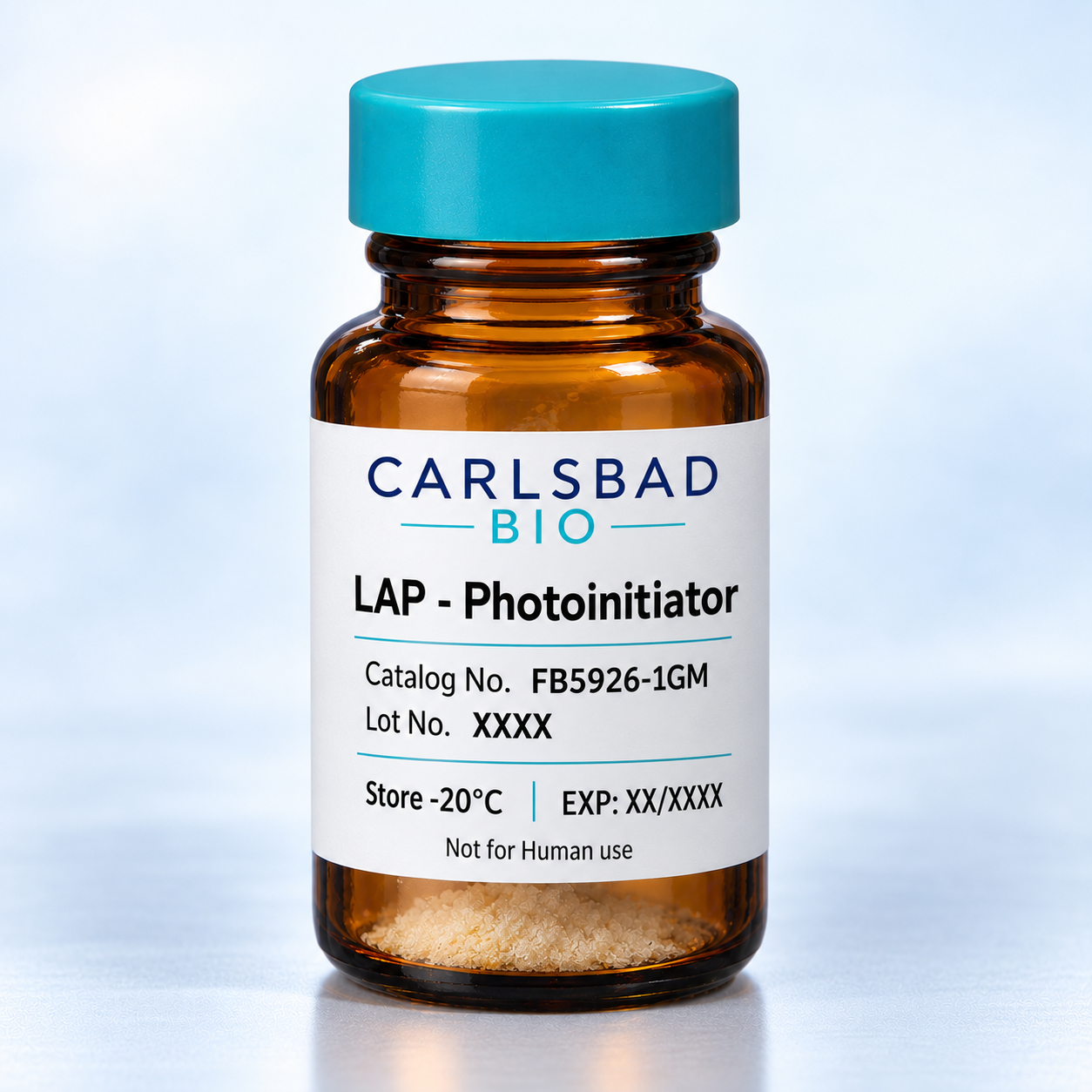
LAP Photoinitiator
LAP (Lithium Phenyl-2,4,6-trimethylbenzoylphosphinate) is a highly efficient, water-soluble photoinitiator widely used for the photocrosslinking of hydrogels and biomaterials.
LAP is supplied as 1 gram of non-sterile powder that can be sterile filtered for cell applications.
Activated by UV and visible light, LAP enables rapid free-radical polymerization of methacrylated and acrylated polymers, making it ideal for 3D bioprinting, tissue engineering, cell encapsulation, and hydrogel fabrication.
Compared to traditional photoinitiators such as Irgacure 2959, LAP offers improved water solubility, faster photocrosslinking, and activation at longer wavelengths, including 405 nm visible light. Its efficient polymerization at relatively low concentrations makes it a popular choice for cell-laden hydrogels and other biological applications.
Key Features & Benefits
Water Soluble: Easily dissolves in aqueous solutions without organic solvents.
Rapid Photocrosslinking: Efficient polymerization under 365–405 nm light.
Versatile Compatibility: Suitable for GelMA, HAMA, PEGDA, methacrylated collagen, and other photocrosslinkable biomaterials.
Cell-Compatible Applications: Commonly used in cell encapsulation and bioprinting workflows when appropriately formulated and validated.
Low Working Concentrations: Typically used at final concentrations of 0.05–0.5% (w/v), depending on the application.


